
Search Cedar Rapids Streets Stepwise
Begin with the exact address as Cedar Rapids records it. The quadrant is part of the identity because 1st Avenue and the Cedar River form the city address baselines. Dropping NE, NW, SE, or SW can point to a different street segment. Use the city assessor for a parcel inside Cedar Rapids. If the address lies outside the city assessment system, switch to Linn County GIS rather than forcing the city form to return it.
- Enter the house number and street in the Cedar Rapids assessor search, preserving the quadrant and suffix.
- Copy the PIN or GPN, situs address, legal description, dated owner field, and any book, page, or instrument reference.
- Open the recorder instrument in Linn County AVA and compare its parties, date, and legal description with the parcel.
- Check election geography for the precinct and districts. A full voter list is a controlled request, not an open household search.
- For an older name, search the directory street guide and image around the year in question.
This chain keeps parcel ownership, voting geography, and printed occupancy in their proper lanes. It also gives a fallback when one portal has no hit: legal description, instrument number, the Recorder counter, or a library image can carry the search forward.
A street-wide project needs a simple research log. Save the exact address entered, whether the city-only box was on, the parcel identifier returned, and the date of the search. Then note which source supports each name. This keeps a deed party from being described as a resident and prevents an old directory entry from being treated as current. The Cedar Rapids address trail is strongest when every row preserves its own date and jurisdiction.
Cedar Rapids Records by Street
A street directory becomes more reliable when each claim is tied to its keeper. Cedar Rapids and Linn County divide parcel work by jurisdiction, while the Recorder maintains the land index and the city maintains permits. Election tools describe district placement and polling details. Historical collections add dated names and address forms.
| Record Set | Keeper | What It Shows | Access |
|---|---|---|---|
| City parcel roll | Cedar Rapids City Assessor | PIN, situs, legal and assessment fields | Free web form and office |
| County parcel GIS | Linn County GIS | GPN, owner fields, taxes, geometry, recorder link | Free map and REST layer |
| Deeds and liens | Linn County Recorder | Parties, dates, book/page, instrument, legal description | AVA, counter, mail, dropbox, phone |
| Election geography | Linn County Elections | Precinct, districts, ballot, polling place | Address lookup; voter lists by controlled request |
| Building permits | Cedar Rapids Building Services | Permit, address, contractor, status | Public viewer; results capped at 50 |
The parcel number and legal description provide the best joins. A street label may change, but the lot and instrument trail can survive. For a full named-street study, record the query date and source beside each row so a current parcel result is never mistaken for a timeless resident list.
The voter channels require special care. The public county address tool resolves election geography, not names. A full list request asks for the requester's identity, intended use, selected fields, format, and payment. County lists can include registration and mailing address, name, precinct code, status, and selected vote-history dates, but protected identifiers are excluded. The request may take up to 14 days and is unavailable during the stated election blackout. These controls make it unsuitable as a casual Cedar Rapids street directory export.
Cedar Rapids Street Search Fields
The Cedar Rapids residential parcel search does not expose an owner-name field. It is built for address, parcel, business, legal-description, and acreage searches. Start narrowly, then remove a field if the result set disappears.
| Field | Input rule | Best use |
|---|---|---|
| Parcel Number/PIN | Up to 35 characters; percent wildcard accepted | Strongest parcel key |
| Doing Business As | Up to 80 characters | Recorded site or business name |
| House number | Optional number | Pair with the street |
| Street name | Up to 50 characters; city-only box defaults on | Browse one Cedar Rapids street |
| Legal description | Up to 35 characters | Match lot or quarter-section text |
| Lot area | Minimum and maximum acres | Coarse filter, never sole proof |
The assessor form shown here makes the address-first design clear.
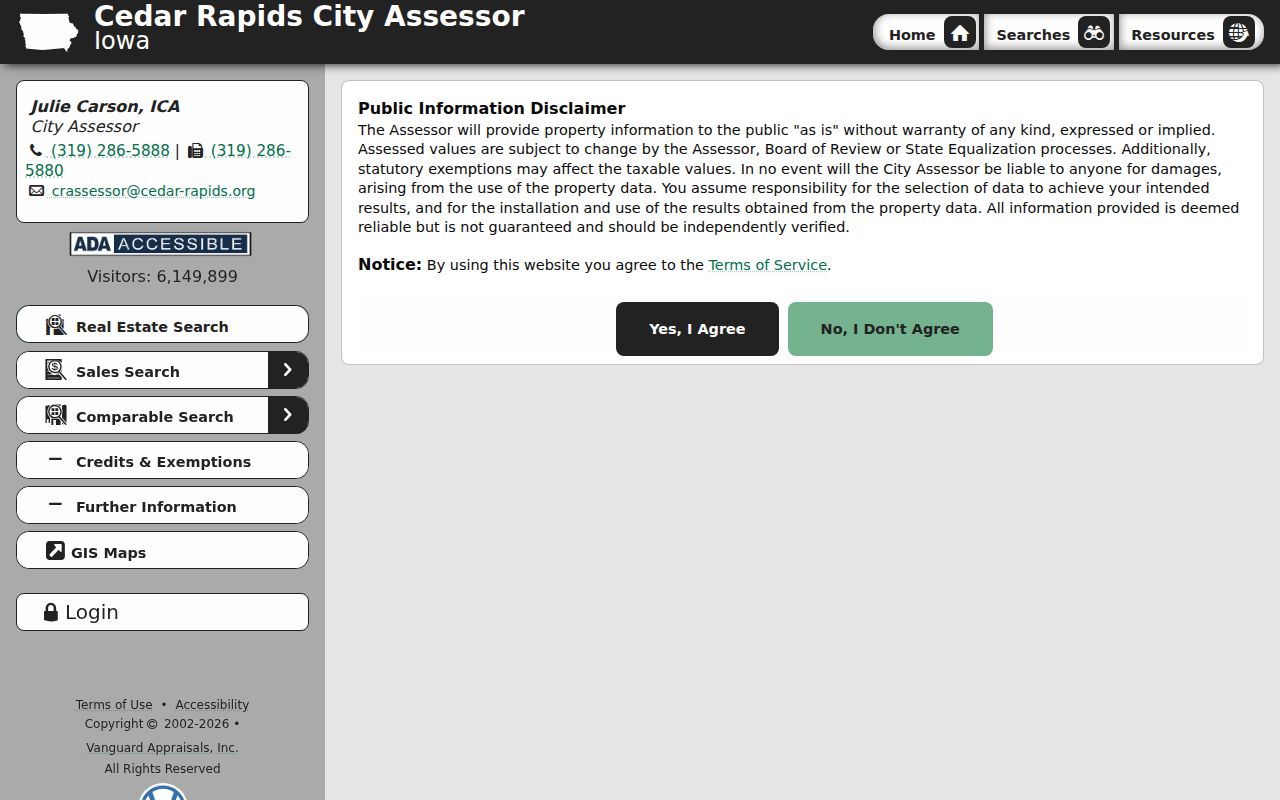
The form supports a Cedar Rapids street directory search without implying that the displayed deed holder is the present occupant.
Cedar Rapids Parcels Meet Deeds
City and county GIS layers provide the bridge from a street address to the Recorder. City fields include house number, street name, deed holder, contract interest, class, acreage, values, and map identifiers. The Linn County layer adds situs ZIP, GPN, legal description, assessment and tax years, book, page, and instrument number. Those fields are leads, not title proof.
- Parcel
- A mapped unit of land with its own identifier.
- Situs address
- The address where the parcel lies, distinct from a tax mailing address.
- Plat
- A recorded map that divides land into lots, blocks, or other units.
- Criss-cross directory
- A directory arranged by address or street instead of only by surname.
When the layer supplies an instrument number, search that value in AVA before trying a common name. The number is more precise and can be checked against the same legal description shown in GIS.
The county sample illustrates the depth of the join without serving as a claim about any present resident. Its parcel response included situs, ZIP, lot text, assessment year, acreage, tax fields, recorder date, book, page, instrument, and direct links. That is enough to reproduce the path from map to deed. It is not enough to say who sleeps at the address or who else is tied to it.
Cedar Rapids Street Deed Trail
The Linn County AVA index accepts party names, document type, dates, book/page, instrument number, subdivision, municipality, and legal-description text. Search a bounded date range and confirm the municipality when the same street name appears elsewhere in Linn County. An empty result means only that the chosen query found nothing.
The recorder index capture shows the official route from a GIS reference to a recorded instrument.
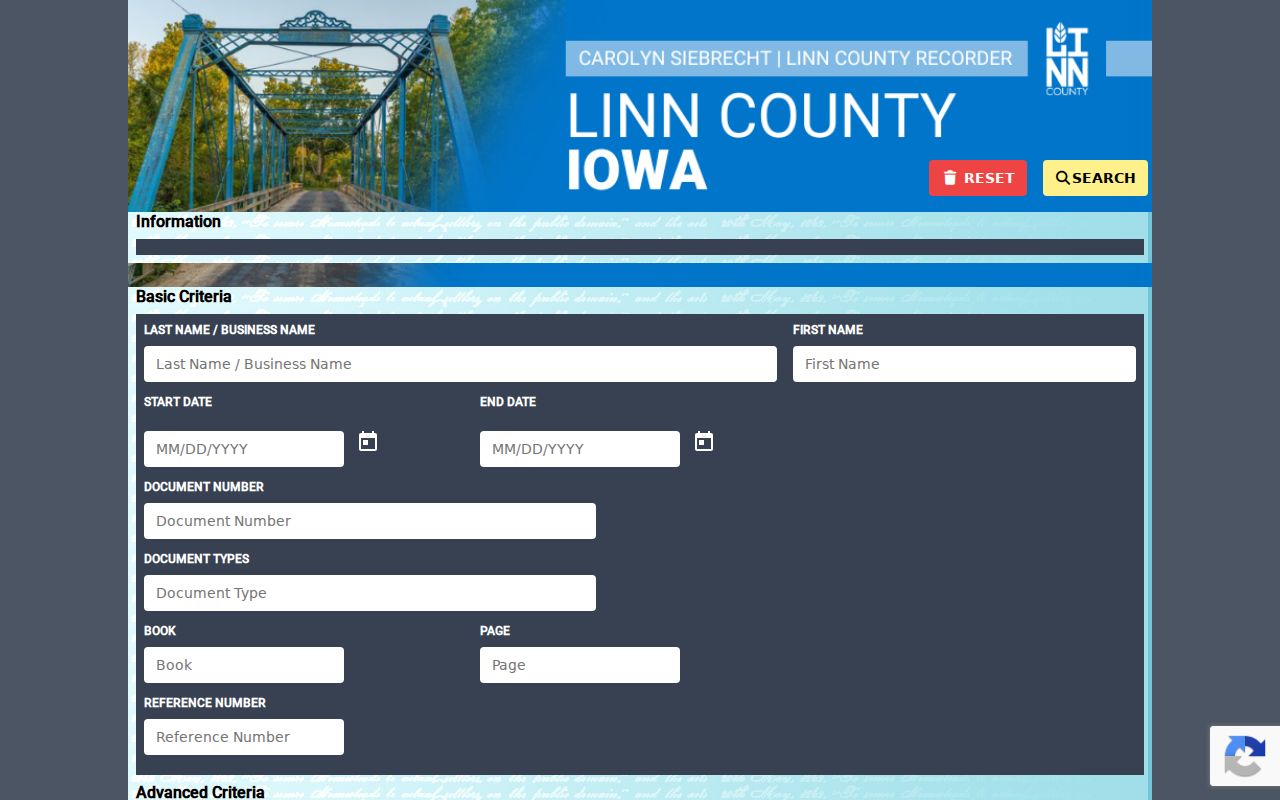
Office holdings reach the 1850s, though the exact AVA web cutoff is not published. Earlier land and town-lot books also route through the Recorder and State Historical Society finding aids.
Recorder access does not stop at AVA. The office serves the counter, mail, dropbox, and phone channels. Copies cost $1 per page, and certification adds $5 per document plus the page charge. Ask for the current schedule before ordering. Staff can help explain document type and legal description, but cannot provide legal advice or turn a land index into a resident roster.
Cedar Rapids Quadrants Matter
NW, NE, SW, and SE are not decorative parts of a Cedar Rapids address. The city grid uses 1st Avenue and the Cedar River as baselines. Preserve the printed quadrant in a directory, deed, permit, or postal result. If an old entry and a current parcel disagree, compare adjacent directory years, the legal description, and nearby lots before treating the two addresses as the same place.
Key point. A one-letter quadrant error can move a street search to the wrong parcel or archive page.
No official citywide renumbering date was found. That gap makes dated source images and legal descriptions more useful than a guessed conversion.
Cedar Rapids Address Event Records
Building permits and election geography add context without proving occupancy. The city permit viewer reports permit, address, contractor, status, and sortable results, with a 50-result cap. A permit marks an administrative event at an address. It may identify a contractor or applicant whose connection is narrower than living there.
The Linn County address lookup returns precinct, districts, ballot, and polling place. The Iowa voter verification form uses name, ZIP, house number, and birth date. A broader county voter list requires a signed request, a permitted civic or political use, and fees under Iowa Code sections 48A.38 and 48A.39. Protected-address programs can also limit what appears.
Cedar Rapids Streets in Print
The Community History Archive holds directories and phone books from 1876 through 2017. Its query can combine a name or street with an AND term, date range, item type, title, decade, and year. Search OCR first, then inspect the page image because initials, abbreviations, and quadrant letters are often misread.
The collection reports 132,763 directory pages. Its Sanborn run adds 197 map pages from 1884 through 1936, while the Linn County census collection contains 7,818 pages from 1840 through 1930. A Sanborn sheet supplies block and building context, not a resident name. Pair it with a dated directory or deed. The full shelf is treated on the Cedar Rapids city directory page.
Cedar Rapids Street Search Fallbacks
Online tools are only one access channel. The Linn County Recorder accepts counter, mail, dropbox, and phone inquiries at 935 2nd Street SW, and keeps land material reaching the 1850s. The Downtown Library offers local history tools and in-library databases. The Genealogical Society of Linn County reports directories from 1869 onward, but exact reverse-directory years must be confirmed with volunteers.
- Try a PIN, GPN, legal description, book/page, or instrument number.
- Bound the AVA or archive search by date.
- Check the page image beside an OCR hit.
- Ask the Recorder about older books and certified copies.
- Use State Historical Society land and town-lot finding aids for early years.
Iowa Chapter 22 also permits oral or written requests for existing public records. An agency need not create a household list or infer a resident relationship that its records do not contain.
Cedar Rapids Street Directory Limits
A parcel owner is not necessarily an occupant. A deed does not list every person at a site, and a tax mailing address may be elsewhere. Election geography does not reveal a household. Current utility customer details and motor-vehicle address data are not open resident rolls. Historic directories also capture one dated publication, not continuous presence.
Lawful use. Use Cedar Rapids address records for lawful personal research, and never to stalk, harass, intimidate, or harm anyone.